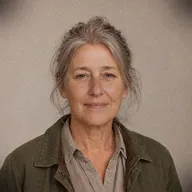
Margaret Sinclair is a long-time home gardener who has grown perennials, shade plants, and container gardens for more than three decades. She writes the perennials, shade plants, container gardening, and raised bed gardening hubs for Caledonia Garden Centre.
Trial bed at a glance
- Soil: Sandy loam over compacted clay, pH 6.4. Leaf mold and compost are the only amendments applied every year.
- Sun exposure: Full sun on the south slope, part shade under mature sugar maples, dense shade on the north side of the garage.
- Wind exposure: Prevailing west wind, no windbreak. Plants rated as “needs shelter” usually do not survive here.
- Deer pressure: High. The trial bed is on a deer flyway, which is why half of the recommended plants are deer-resistant.
What Margaret actually grows
The trial bed holds roughly 240 perennial species and cultivars at any given time, rotated as new entries are added and weak performers are removed. The longest-running clumps include a 1996 peony (Paeonia lactiflora ‘Sarah Bernhardt’), a 2001 Siberian iris (Iris sibirica ‘Caesar’s Brother’), and a 2003 bleeding heart (Lamprocapnos spectabilis) that has not been divided in over twenty years. All three are still blooming.
Method
- New plants go in the ground in spring only, in 1-gallon or smaller sizes, to give roots a full season to anchor before the first real winter.
- Plants are watered through the first full summer and the first full fall. After that, they get whatever rainfall arrives.
- Weeds are pulled by hand. No herbicides are used anywhere on the property.
- Pesticides are limited to soft controls: insecticidal soap for aphids, Bt for cabbage worm, and hand-picking for everything else.
- Records are kept in a paper notebook by the back door. Bloom time, height, disease pressure, and the date of first frost are all logged.
Sources Margaret leans on most
- Missouri Botanical Garden Plant Finder - the go-to source for cultivar data and care notes on 7,500+ plants.
- USDA NRCS Plants Database - native range and conservation status for North American species.
- University of Minnesota Extension - cold-climate vegetable and flower production.
- Lady Bird Johnson Wildflower Center - native plant selection.
- Royal Horticultural Society plant selector - UK and global cultivar data.
Things Margaret will not write about
- Lawn care beyond a few paragraphs. Her lawn is a 200-square-meter patch of Kentucky bluegrass and clover. It is fine.
- Bonsai. She tried, killed three junipers, and moved on.
- Anything she has not grown for at least two full seasons. If a plant has not made it through a real winter with normal fall care, it does not get recommended.
- Anything she would not plant in her own yard. The trial bed is the filter.